


Introduction
Starting a credit repair business does not take an office, employees, or a certification course. It takes a legal setup done right, a way to read credit reports, a way to send disputes, and one client you can actually help. This chapter is the setup, in order.
How I got started
Before we start, I wanted to share a quick story about how I got started. I started my credit repair business in 2020, and it was a long shot. I never had much information on how to start a business, but I did find a course that cost $1,000 to learn how to dispute inaccurate info off of credit reports. I studied it religiously and found great information and real success with it, but I still had to establish myself as the credit guy and learn how to build a real business.
I started with a network of friends and family. Eventually, after trial and error, I learned that I could actually remove negative items from other people's reports, and it started to build momentum. But there was a lot of marketing that had to go into it.
As the business grew, I used both of the major disputing platforms, DisputeFox and Credit Repair Cloud, and I kept wondering to myself why it felt like they didn't actually care about my business. They didn't want to help me become compliant. They actually made it harder. And they didn't care if I scaled the business, only if I paid my monthly subscription.
They barely showed the metrics for success either. Is this methodology working? Are my disputes effective? Is my client engaged? Everything I feel is extremely important from a business perspective, and I couldn't see any of it.
That's how DisputeWell started, and that's the story. The rest of this guide is everything I had to figure out along the way.
Is this business for you?
Honest picture first. This is a service business with recurring revenue, which is the good part. Clients pay monthly, results take rounds, and your reputation compounds. The clients you are serving are people who have a hard time paying their bills, and that can be you too.
You are also contributing a large portion to their financial wellness. There will be many people who are able to buy their first home because of your hard work and effort. Trust is everything and shortcuts can get you sued. If you want a passive income hack, this isn't it. If you want a real business helping people with a problem that genuinely ruins lives, keep reading.
Federal Law: CROA
Start with the federal law, because it applies to everyone: the Credit Repair Organizations Act, CROA. Congress wrote it specifically about businesses like yours, and it's readable, but not always easily understood.
You need a written contract with specific disclosures, including a notice of your client's rights. Every client gets three business days to cancel after signing. You can't charge for work before it's performed, which is why this industry bills monthly, after the work. And you can never advise anyone to lie, to dispute accurate information as inaccurate, or to build a new credit identity to escape their file.
None of this is optional, it is the law and it will affect you. The largest company in this industry's history was hit with a $2.7 billion judgment, but if you follow the law from day one, none of that will ever be your problem. We are the only major platform that actually includes tools for you to monitor your compliance, and whether each client you're working for is compliant too.
Now, there is real nuance in what you can and cannot do. A quick taste: you can dispute anything inaccurate, unverifiable, or incomplete, but you can never guarantee a deletion or promise a score, no matter how confident you are. That line is where businesses get in trouble, and DisputeWell bakes the guardrails in. We'll go deeper on the do's and don'ts as the guide grows. For now, your state's rules.
Read it yourself: The full text of CROA, 15 U.S.C. §1679 · The FTC's CROA page
Your state's rules
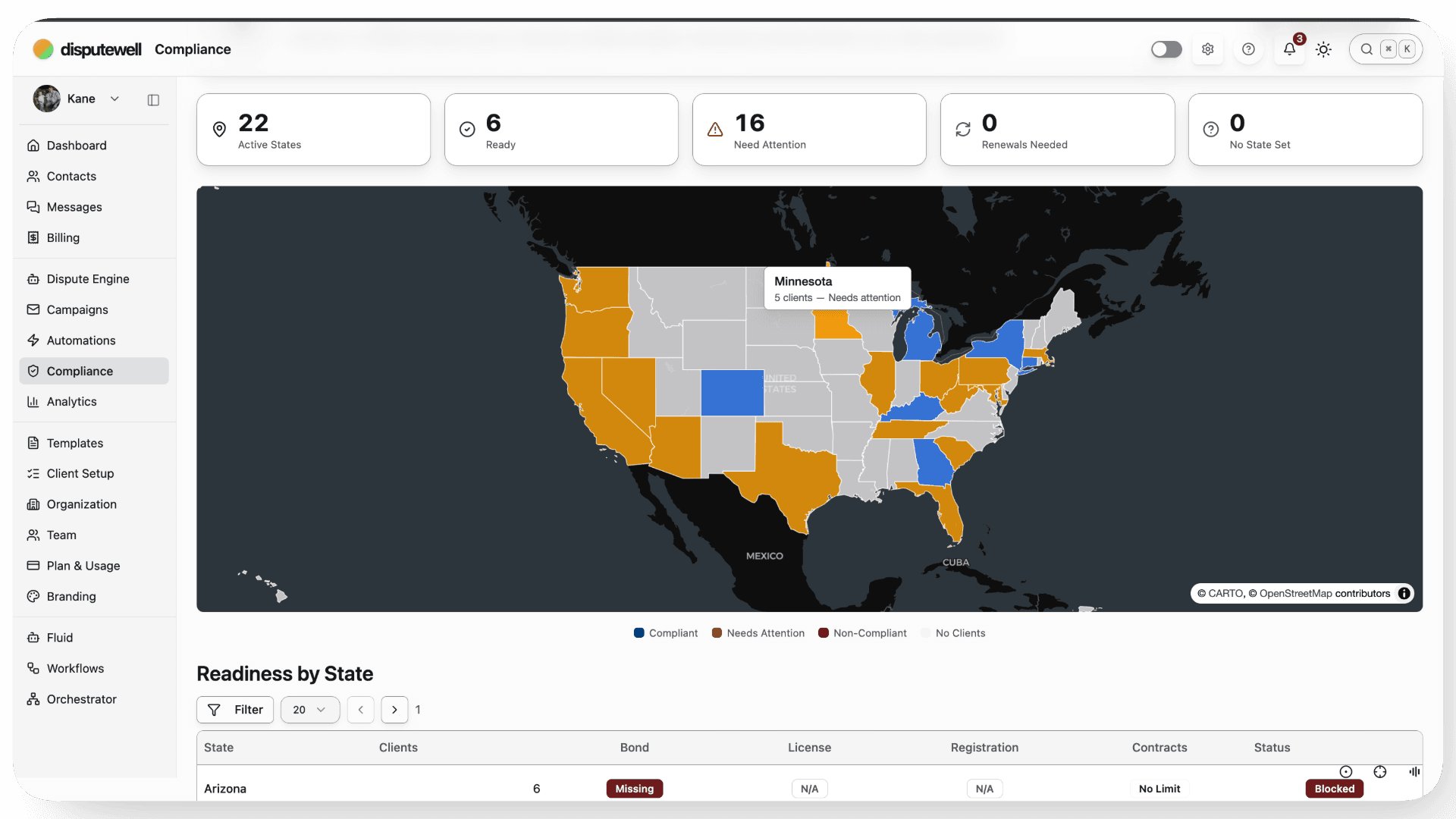
Next are the state-specific rules, still just as important as your federal law. Every state genuinely is different. We track all 53 US jurisdictions inside DisputeWell, so the system knows if you need a certain agreement, bond, or license.
36 states require a surety bond. A bond isn't money you park somewhere: you pay a small annual premium, usually a percent or two of the bond amount, and a surety company guarantees the rest. The amounts run from $5,000 in the lightest states up to $100,000, and Kansas can technically require up to $1,000,000. 25 states want you registered with a state agency before you operate, and seven go further and require a dedicated credit repair license: Idaho, Kansas, Maryland, Mississippi, Oklahoma, South Carolina, and Puerto Rico.
Contracts get state verbiage too. 34 states set their own cancellation window, anywhere from 3 to 10 days, and eleven cap how long a contract can even run. Ohio caps it at 60 days, Michigan at 90, most of the rest at six months, and South Carolina lets you go five years. If your contract doesn't match your state's rules, it may not be enforceable at all. Which obviously is bad from a legal perspective. We set reminders for when contracts need to be renewed and things as well.
This is the part of starting up where people stall for months. Don't. Look up your state, get the bond quote, file the registration if you need one, and move. And if your state's rules read strict or strange, spend the few hundred dollars on a lawyer consult before you spend anything else.
Forming the company
Forming the company is simpler than it sounds, and you can do the whole thing in an afternoon. Pick a business name, file an LLC on your state's Secretary of State website (most states charge somewhere between $50 and a few hundred dollars), and grab your EIN from the IRS website. The EIN is free and takes about ten minutes, and it's what lets your business exist on paper. The bank account, the bond, and your state registration all require that number too.
Then open a business bank account and run every dollar of the business through it. Client money and personal money should never touch. You're a regulated business handling other people's financial lives, and if anyone ever asks questions, clean books from day one will set you up for success.
Here's another significant thing to mention about this industry, banks and payment processors treat credit repair as a high-risk. Some of the large processors simply will not serve you. That's not a reflection of your business, it's their policy, so plan around it from the start. Use a payment gateway that accepts credit repair, and be upfront about what your business does when you open accounts, because getting shut down mid-operation hurts a lot more than being told no on day one.
Because of that high-risk label, getting a bank and merchant account can be more tedious than it needs to be. That's a problem with the industry's reputation, not with you. And it's part of why we built DisputeWell the way we did: our hope is that through data, documented outcomes, and provable compliance, credit repair stops being a high-risk industry at all.
You don't need an office, you can be your own registered agent, and you don't need some special out-of-state corporation. Your own state, a simple LLC, a real bank account, and a processor that accepts your industry. That's the whole checklist.
Your toolkit
You need three things. A credit monitoring service your clients sign up for, so you can pull their reports every month. Software to read those reports, find what's disputable, and write the letters. And a way to print and mail everything with tracking, because every dispute in this industry travels by mail. (you can fax too, but that's not the best way to do it)
Your first client
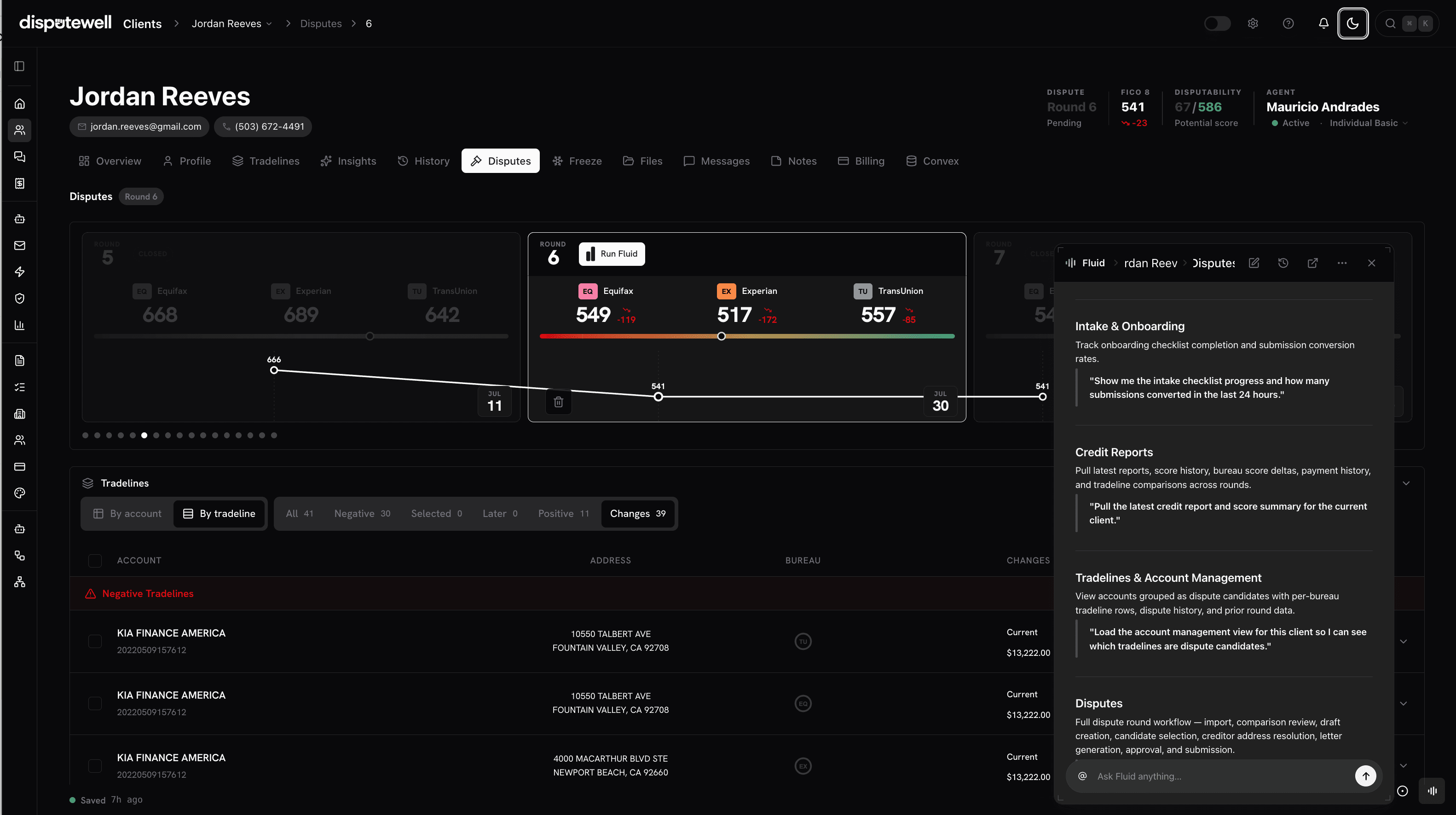
Start with someone whose situation you know, a friend or family member with real negatives on their report. Pull their reports inside of Disputewell with our one click import, let your agent fluid find the best disputable items, and generate your reasons and instructions based off of the full report and situation context.
Fluid is trained on thousands of successful disputes and will generate the strongest reasons and instructions for you. You are a credit repair professional, and your disputes deserve to be top of the line. You'll learn more from one real round than from a month of videos. And that first deletion letter is the moment people will start to realize this is the real deal.
Pricing your service
Most of this industry charges monthly, and this is where some of the CROA nuance comes into play. You charge after work is performed, some people consider that the consultation and analysis, others say it's when the score increases, or items are deleted.
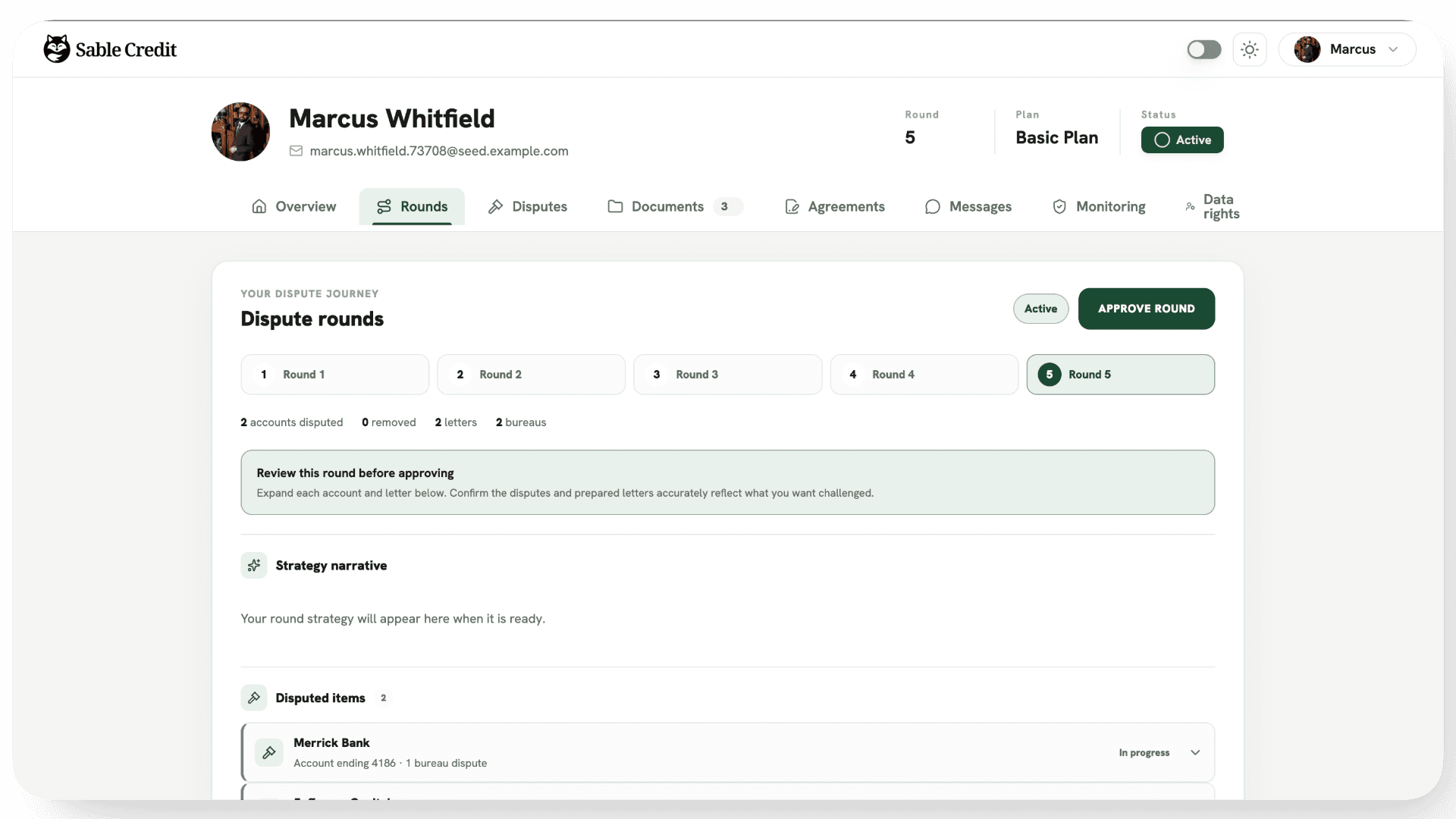
This is where the portal becomes important. Your clients log in under your brand and see the accounts that have been disputed, letters sent, score changes, what got sent, what came back, etc. They can review and approve their upcoming disputes, watch their score history, upload documents when you need them, message you, and pay their invoice, all in one place. Every one of those touches is your monthly price defending itself.
Clients more often than not would've just messaged me directly instead of using the portal in other softwares. We want our portal to be a real benefit to your company, so it is more interactive and engaging than the other softwares, which by proxy helps make you more compliant as well.
Take the leap
Here's what week one actually looks like. Form the LLC and grab your EIN. Look up your state and start the bond or registration if you need one. Get your CROA contract in place. Sign up for a monitoring service, pick your software, and enroll your first client, even if that first client is your cousin.
None of those steps are hard. What's hard is that nobody is going to make you do them. There's no boss, no deadline, and no perfect moment coming. Most people who want to start this business stay stuck at wanting: reading one more thing, watching one more video, waiting until they feel ready.
When I started in 2020, I had a $1,000 course and a list of friends and family. You have the entire legal map, the actual mechanics of disputing, and software that does most of the work for you. You're starting with more than almost anyone who has ever built one of these businesses.
So take the leap. Enroll one person this week. And when their reports come in and you're staring at three bureaus' worth of accounts wondering what to dispute, that's Chapter II.